Getting Started with Foreign Qualifications
An analysis of credential evaluations in the Netherlands between 2021 and 2025
Nuffic has been issuing qualification assessments for decades to provide insight into how foreign qualifications compare with the Dutch education system. Qualification assessments are increasingly being used to improve the labour market prospects of newcomers to the Netherlands. This study provides an overview of the qualifications that have been assessed by Nuffic and the Foundation for Cooperation on Vocational Education, Training and the Labour Market (Samenwerkingsorganisatie Beroepsonderwijs Bedrijfsleven (SBB)) in recent years.
Key Findings
Between January 2021 and December 2025, 78,351 qualification assessments were issued by Nuffic and the Foundation for Cooperation on Vocational Education, Training and the Labour Market (Samenwerkingsorganisatie Beroepsonderwijs Bedrijfsleven (SBB)). These qualification assessments set out how a foreign qualification compares to the Dutch education system.
- Three-quarters of the credential evaluations corresponded to university of applied sciences degrees (UAS), research university degrees (RU), or PhD degrees;
- Most of the credential evaluations comparable to UAS or RU degrees were in the fields of Engineering (15,440 evaluations) and Economics (11,790 evaluations). For vocational education and training (VET) diplomas, the most common fields were Healthcare, well-being, and sports (3,400 evaluations) and Engineering and the Built Environment (1,610 evaluations);
- 36% of the credential evaluations were requested mainly for the reason of working in the Netherlands; the largest number of these credentials originated from the United Kingdom, Türkiye, and Italy;
- 30% of the credential evaluations were requested as part of the civic integration process; diplomas from Syria and Türkiye were the most frequent in this category.
Introduction
Every year, new people arrive in the Netherlands, such as refugees, migrants and international students. Many of these people have completed their education abroad. There is only limited information available about which qualifications these people bring with them, even though they play a key role in subsequent steps in education and on the labour market (Algemene Rekenkamer, 2026).
In recent years, greater emphasis has been placed on better recognising and utilising foreign qualifications. The Social Economic Council (SER) and the Advisory Council on Migration recently called for more insight into the skills and qualifications of newcomers (SER 2026, Adviesraad Migratie2026). In the Talent Strategy (‘Talentstrategie’), the government emphasises that the Netherlands must make greater use of talent that is already present here (Rijksoverheid, 2026a). The Ministry of Social Affairs and Employment is also working on measures to guide status holders and asylum seekers with a high chance of receiving refugee status into suitable employment more quickly and more frequently (Rijksoverheid, 2026b).
To achieve this, knowledge and transparency regarding foreign qualifications are required. Not only amongst policymakers, but also amongst educational institutions, employers and other organisations that make decisions regarding training and employment. For them, it is not always clear how a foreign qualification compares to a Dutch one. That is why Nuffic and the Foundation for Cooperation on Vocational Education, Training and the Labour Market (Samenwerkingsorganisatie Beroepsonderwijs Bedrijfsleven, SBB) ) are responsible for issuing
. These assessments specify the level and field of study within the Dutch education system to which a foreign qualification is comparable.
This study shows which qualifications were evaluated by Nuffic and SBB during the period 2021–2025. This is the first time that data on credential evaluations in the Netherlands have been analysed and published. Whereas until now the focus has mainly been on the number of credential evaluations issued, this study reveals the levels of education and fields of study involved. It thereby contributes to a better understanding of the talent coming to the Netherlands.
What is the purpose of credential evaluations?
In Europe, people with a foreign qualification have, on average, a less favourable position in the labour market than those with qualifications from the country in which they live and work. They are more likely to be unemployed or overqualified, which means that they are working below their own level of education (Brücker et al., 2021).
One possible explanation is that foreign qualifications are not always recognised by employers, which can result in this group being unable to find suitable work (Brücker et al., 2021; OECD, 2017). A credential evaluation provides employers with a better understanding of the level and value of a foreign qualification and can therefore help rectify this disparity (Brücker et al., 2021; Tibajev & Hellgren, 2019). This helps employees with foreign qualifications make better use of their skills and knowledge, find suitable work more often and earn a higher salary.
Research shows that people with a credential evaluation have a higher labour force participation rate (CBS, 2023), earn higher wages (Brücker et al., 2021), and are less likely to be overqualified (Bakker, 2015). Credential evaluation can therefore ensure that the human capital of people with foreign qualifications is utilised more effectively, which may lead to reduced labour market shortages (OECD, 2025), improved economic and social integration (Liebig & Huddleston, 2014), higher GDP per capita (Dutch Government, 2025, pp. 69–70), and more equitable access to education and employment (UNESCO, 2026).
Reasons for a credential evaluation
Individuals can apply for a credential evaluation via the online portal
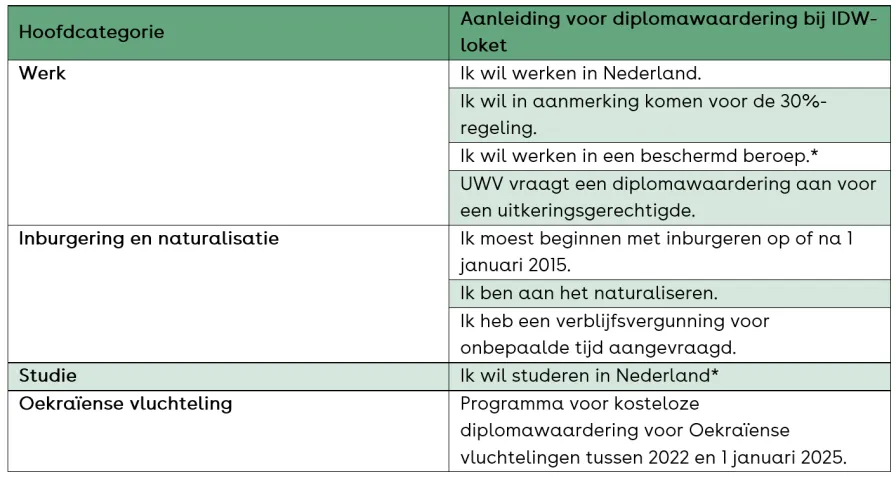
(‘Internationale diplomawaardering', IDW). Based on the applications submitted via IDW, this study identifies various reasons for applying for a credential evaluation. The main categories include work in the Netherlands, naturalisation and civic integration, study in the Netherlands, and Ukrainian refugees.
The ‘work’ category comprises applications that are submitted for a
. A credential evaluation is not compulsory for working in the Netherlands; it is, however, used to improve one’s position in the labour market by demonstrating how a qualification relates to the Dutch education system. Far from all employees with a foreign qualification apply for a qualification assessment (Kool et al., 2025).
To be eligible for a reduced salary threshold under the
, it is usually necessary to provide proof, in the form of a credential evaluation, that a degree at university master’s level has been obtained. Some professions are regulated in the Netherlands. For these professions, a separate professional recognition procedure must be followed via the competent authorities for the relevant sector. People with a foreign qualification for a regulated profession can, however, apply for a credential evaluation via the IDW to determine which Dutch qualification it is comparable to before they begin the professional recognition procedure.
For people undergoing civic integration or seeking naturalisation, a credential evaluation is free of charge but not compulsory. Only a share of them apply for a credential evaluation. By 2024, 18 per cent of those participating in civic integration in the 2022 cohort had applied for a credential evaluation (Algemene Rekenkamer, 2026). Previous research found that it is not clear to all civic integration participants that a credential evaluation can help them gain access to the labour market (Stavenuiter et al., 2019, pp. 50 & 64); this applies in particular to migrants with vocational education (Kool et al., 2025). Furthermore, it is possible that (highly skilled) migrants who have been already working in the Netherlands for some time and are applying for a permanent residence permit or seeking naturalisation are less inclined to apply for a qualification assessment, as they are already active in the Dutch labour market.
To study in the Netherlands it is not necessary to apply for a qualification recognition from the IDW. Educational institutions decide on admissions themselves, possibly on the basis of the country modules or recommendations from Nuffic (higher education) or SBB (vocational education). These recommendations have not been included in this study. However, a prospective student can apply for a
to find out how their qualification is assessed. These credential evaluations have been included in this study.
The appendix ‘Further reading’ contains further information on how a qualification is assessed and how Dutch credential evaluation compares to that of neighbouring countries.
| Hoofdcategorie | Aanleiding voor diplomawaardering bij IDW-loket |
| Werk | Ik wil werken in Nederland. |
| Ik wil in aanmerking komen voor de 30%-regeling. | |
| Ik wil werken in een beschermd beroep.* | |
| UWV vraagt een diplomawaardering aan voor een uitkeringsgerechtigde. | |
| Inburgering en naturalisatie | Ik moest beginnen met inburgeren op of na 1 januari 2015. |
| Ik ben aan het naturaliseren. | |
| Ik heb een verblijfsvergunning voor onbepaalde tijd aangevraagd. | |
| Studie | Ik wil studeren in Nederland* |
| Oekraïense vluchteling | Programma voor kosteloze diplomawaardering voor Oekraïense vluchtelingen tussen 2022 en 1 januari 2025. |
Tabel 1. Aanleidingen voor het aanvragen van een diplomawaardering
bij IDW-loket
* Bij aanvragen met als aanleiding ‘studeren in Nederland’ en ‘werken
in beschermde beroepen’ geeft de website van het IDW aan dat een
aanvraag bij IDW niet nodig is om je aan te melden bij een
onderwijsinstelling en dat een diplomawaardering via IDW niet
voldoende is om het beschermde beroep uit te voeren.
Scope of the study
In this publication, we first outline a general overview of the credential evaluations requested between 2021 and 2025. We report on the number of credential evaluations issued for the various reasons described in Table 1. We also describe the most common countries of origin for the degrees. We then zoom in further on the levels of education of the evaluations issued and on the fields of study. On the webpage ‘Qualifications from Turkey, Syria, Ukraine and the UK highlighted’, we provide a more detailed overview of the context for credential evaluations from Türkiye, Syria, Ukraine and the United Kingdom.
Data and Methodology
In this study, we analyse the credential evaluations requested from Nuffic and SBB via the IDW portal between 1 January 2021 and 31 December 2025. Of the 99,934 applications received during this period, 78,351 resulted in a credential evaluation, which form the subject of this
.
At the time of the data export (June 2026), some of the applications from 2025 had not yet been processed. As a result, the number of qualification assessments in 2025 is lower than in previous years in this analysis.
The level of education and field of study are not available as separate variables for all evaluations. To ensure that all credential evaluations can be included in the analysis, we use classification models to derive the level of education and field of study from the description of the credential evaluation. Evaluations of the models show this to be an accurate method. However, some credential evaluations will have been incorrectly classified. To partially mitigate this uncertainty, all figures in this report have been rounded to the nearest ten. Further information on the classification models can be found in the appendix Classification model methodology.
Results: General Overview
Number of credential evaluation by reason for application
Figure 1 shows the reason for the credential evaluations issued from 2021 to 2025. The most common reason for a credential evaluation is to work in the Netherlands. Between 2021 and 2025, 28,200 evaluations were issued for this purpose (36.0%). A smaller group applied to qualify for the 30% ruling (7,330; 9.4%).
The second most common reason for applying for a qualification assessment is as part of civic integration. A total of 23,250 (29.7%) qualifications were assessed for this purpose.
Figure 1. The number of credential evaluations broken down by reason for the application

Applications for the recognition of qualifications obtained in recent years were more frequently made with the aim of working in the Netherlands, whilst applications for the recognition of qualifications for naturalisation and civic integration were more often obtained some time ago.
Applications for the recognition of qualifications submitted to qualify for the reduced salary threshold under the 30% ruling were, on average, made most quickly after the qualification was obtained (2.8 years). This suggests that many applicants choose to have their qualifications recognised in the Netherlands shortly after graduating. For the reason ‘I want to work in the Netherlands’, there is an average gap of 7.8 years between obtaining a qualification and applying for a credential evaluation. For credential evaluations in the context of civic integration, this figure is 9.9 years.
Top 10 Countries of Qualification
We only have information about the country in which the applicant obtained their qualification, i.e. the country of qualification. We do not have data on the applicants’ countries of origin.
Between 2021 and 2025, qualifications from Türkiye were the most common in the Netherlands, with 9,480 credential evaluations (see Figure 2). These were followed by qualifications from Syria (7,270), Ukraine (6,440) and the United Kingdom (5,260) (see Qualifications from Türkiye, Syria, Ukraine and the UK highlighted for more information on these countries). Together with Italy (3,290), these countries made up the top five countries of origin for credential evaluations.
Figure 2. Number of credential evaluations in the Netherlands by country of qualification, broken down by reason for application (2021–2025)
The most common countries of qualifications vary depending on the reason for the qualification assessment. For applications falling under the main category ‘working in the Netherlands’, the United Kingdom was by far the most common country of qualification, with over 4,140 credential evaluations. This was followed by Türkiye (2,920) and Italy (2,720).
For qualification assessments under the main category ‘studying in the Netherlands’, Turkey (650), Syria (520) and Morocco (390) were the most common countries of qualifications.
For credential evaluations carried out under the main category ‘naturalisation and civic integration’, degrees from Syria (6,270) and Türkiye (5,700) were the most common.
Level of Education
The credential evaluations describe the Dutch level to which the programme can be compared. This level is derived from the description of the qualification assessment using a .
Number of credential evaluations by level of education
Three-quarters of the credential evaluations were issued for higher education (77.0%; 60,200). The research university (RU) master’s degree is the most common diploma (28.3%; 22,130), followed by university of applied sciences (UAS) bachelor’s degrees (19.9%; 15,560) and 13,450 RU bachelor’s degrees (17.2%).
Secondary education qualifications accounted for 12.8% of the qualifications awarded (10,030), of which havo qualifications were by far the most common, at 8,600 (11.0%). Vocational education and training (VET) qualifications account for 10.2 per cent of the qualification assessments (7,980), with VET level 3 being the most common level (3,420; 4.4 per cent), closely followed by VET level 4 (3,230; 4.1 per cent).
Figure 3. The number of credential evaluations broken down by derived educational level.

Credential evaluations by categorized reasons for application
The distribution of the levels of education varies according to the categorized reason for application (Figure 4). Most credential evaluations are requested for the category ‘I want to work in the Netherlands’, within which master’s degrees are the most common, with 12,100 (42.9%) credential evaluations; of these, 9,850 (34.9%) are RU master’s degrees and 2,250 (8.0%) are UAS master’s degrees. Bachelor’s degrees are also frequently evaluated under this category (10,350; 36.7%), of which 5,990 (21.3%) are UAS bachelor’s degrees, 3,790 (13.4%) are RU bachelor’s degrees and 560 (2.0%) are associate degrees.
The second most common category for applying for a credential evaluation is the civic integration programme. Within this group, more than half of the credential evaluations were issued for a bachelor’s degree (12,750; 54.8%). Of these, 6,270 (27.0%) were RU bachelor’s degrees, 5,710 (24.6%) were UAS bachelor’s degrees and 760 (3.3%) were associate degrees. Secondary education qualifications are also common in this group of evaluations (5,480; 23.6%); these are almost exclusively havo qualifications (5,280; 22.7%).
Credential evaluations for eligibility under the 30% ruling were mainly issued for master’s degrees (6,710; 91.6%), of which 850 (11.6%) were comparable with universities of applied sciences and 5,870 (80.0%) were comparable with research universities. This is understandable, as a research university master’s degree is required to qualify for a reduced salary threshold for young employees (see Introduction).
The group of Ukrainian refugees who were able to have their qualifications evaluated free of charge between 2022 and 2025 mainly had master’s degrees evaluated (2,570; 53.2%), of which 1,280 (26.5%) were UAS master’s degrees and 1,290 (26.8%) were RU master’s degrees. Bachelor’s degrees were also frequently evaluated (1,670; 34.6%), of which 730 (15.1%) were bachelor’s degrees comparable with universities of applied sciences and 840 (17.4%) comparable with bachelor’s degrees from research universities.
Figure 4. The number of credential evaluations broken down by derived level of education and the reason for the application.

Most common countries of qualification by level of education
Although multiple levels of education were common for countries such as Syria, Ukraine and Türkiye (see Figure 5), we still see variation in the most common qualification countries by level of education in the period 2021–2025. For the secondary education level, qualifications from Syria (2,410), Türkiye (1,190) and Yemen (640) made up the top three. Syria also ranked first for vocational education and training (VET) level qualifications (1,490), this time followed by Suriname (900) and Belgium (840). It is notable that almost 80 per cent of the Surinamese qualifications assessed at vocational level were assessed at VET level 4.
For bachelor’s degrees, Türkiye was the most common country of qualification (6,630), of which 2,016 were UAS bachelor’s degrees and 3,912 were RU bachelor’s degrees. Türkiye was followed by Syria (3,180) and Ukraine (2,190). At master’s level, the United Kingdom topped the list (4,380), followed by Ukraine (3,540) and Italy (3,100). Further analysis shows that for more than 90%of the evaluations of Italian diplomas was at the master’s level. This is partly because Italy ranks second, after France, as the country for which evaluations were requested under the 30% ruling. Furthermore, according to regional experts at Nuffic a significant proportion of the credential evaluations of Italian master’s degrees related to applicants with non-EEA nationality who had completed their master’s programme in Italy and subsequently wished to come to the Netherlands to work. In such cases, the Highly Skilled Migrants Scheme may be utilised. It is likely that this scheme is regularly combined with the 30% ruling, as there is considerable overlap in the criteria for both schemes.
At PhD level, the top three countries differ significantly from those at other levels of education. Malaysia ranked first. Malaysia’s position at PhD level may be due to the fact that it has become an attractive destination for international students, particularly from China and other parts of Asia 18 . Malaysia is followed by the United States and China.
Figure 5. Top 10 qualification countries by educational level (2021 to 2025)
Fields of Study
The field of study of the qualification is included in credential evaluations. Using a classification model, we have assigned each field of study to a sector: the sectors as identified by the Institutions an Programmes Registration (RIO, formerly the Central Register of Higher Education Programmes (CROHO)) for higher education (see also: Programme data in RIO: Consult and download – Higher education – DUO Business, in Dutch), and the sector chambers for vocational education (see also: Sector chambers and market segments, in Dutch).
Number of qualification assessments by sector
Vocational Education and Training (VET)
Between 2021 and 2025, Healthcare, well-being and sports was the most common sector in VET credential evaluations. This accounts for almost half of all VE credential evaluations: 3,400 out of 7,970 (42.6%). Technology and the built environment came in second place with 1,610 assessments (20.1%). Both sectors face a significant labour shortage of VE graduates (Sectors with shortages have been offering the highest salaries and the best job opportunities for years – ESB). Assistant training is the least common field of study (50; 0.7%). This category includes VET level 1 qualifications, such as Service Assistant or Logistics Assistant.
Figure 6. Number of credential evaluations by field of study in vocational education, 2021–25

DEZE ALINEA IS NIET VERTAALD...WEGLATEN? In de periode 2021 tot en met 2025 kwam Techniek het meest voor onder diplomawaarderingen op hbo- en wo-niveau. Het gaat om 15.440 van de 60.190 aanvragen (25,6%). Dus ook bij hbo- en wo-diploma’s komt een tekortsector het meest voor bij de gewaardeerde diploma’s (Gediplomeerden in de tekortsectoren gezondheidszorg, onderwijs en bètatechniek | OCW in cijfers). Economie staat met 11.790 aanvragen (19,6%) op de tweede plek. Recht (2.300; 3,8%) en Landbouw en natuurlijke omgeving (1.640; 2,7%) komen het minst vaak voor.
Higher education (HE)
Between 2021 and 2025, Engineering was the most common subject among credential evaluations in higher education. This accounted for 15,440 of the 60,190 evaluations (25.6%). Therefore, a sector facing a shortage of skilled workers is also the most common among credential evaluations in higher education (Graduates in the sectors facing a shortage of skilled workers: healthcare, education and science and technology | OCW in figures). Economics ranks second with 11,790 evaluations (19.6%). Law (2,300; 3.8% and Agriculture and the natural environment (1,640; 2.7% are the least common.
Figure 7. Number of credential evaluations per field of study in higher education (2021–25)

Within Engineering, more master’s-level qualifications (8,590) were evaluated over this period than bachelor’s-level qualifications (6,440). This means that 55.7% of all Engineering qualifications in higher education were evaluated as comparable to master’s degrees, 41.7% as comparable to bachelor’s degrees, and 2.6% as PhDs (410). Similarly, for Economics and Agriculture and the natural environment, more master’s degrees were assessed than bachelor’s degrees. For the other fields of study, there were more assessments at bachelor’s level than at master’s level.
If we look separately at qualifications at bachelor’s, master’s and PhD level, Engineering remains the largest sector across all levels. Economics ranks second for both bachelor’s level (5,040; 16.4%) and master’s level (6,610; 23.6%), but for PhD degrees, Natural sciences is more common (190; 13.9%) and Economics ranks fifth (140; 9.7%).
Additionally, in terms of bachelor’s-level ratings, the field of study Healthcare (4,580; 14.9%) is slightly more common than Behavioural and social sciences (4,220; 13.7%). At master’s level, the situation is reversed: Behavioural and social sciences ranks third (3,770; 13.4%) and Healthcare comes fourth (3,080; 11.0%).
Countries of qualification by field of study
The 10 countries with the most credential evaluations at vocational education level are (in descending order of the number of evaluations) Syria, Suriname, Belgium, Türkiye, Curaçao, Germany, Poland, South Africa, Spain and Iran. Table 3 highlights the top five countries of origin for qualifications per VET field of study.
Table 3. Number and share per top 5 countries of qualification per VE fields of study
N.B. Countries of qualification with N<10 are not shown

For most sectors within VET, Syrian qualifications represent the largest group. In the Trade sector, almost half of the evaluated credentials originate from Syria (48.3%); for the other sectors, Syrian qualifications account for approximately one-sixth to one-quarter of the total. Health, well-being and sports is an exception. Here, most qualifications originate from Surinam (18.7%). This sector also includes education at the VET level.
For the fields of study Assistant training and Specialised craftsmanship, Syria is the second most common country of qualification. Morocco is the leading country of qualification for Assistant training qualifications, accounting for 24.1% of them, whilst Germany ranks first for Specialised craftsmanship (35.0%), although the number of qualifications assessed for this field of study is small.
Generally speaking, the top 5 countries of qualification in each field of study also feature in the top 10 countries with the most VET credential evaluations. The two exceptions to this are India and the Philippines: these countries do not feature in the overall top 10, but qualifications from India account for 10% of Food, greenery and hospitality, and qualifications from the Philippines rank fifth (3.1%) in ‘IT and creative industry.
Table 4. Number and share per top 5 countries of qualification for the higher education fields of study

In higher education, the countries with the highest number of credential evaluations are Türkiye, Ukraine, the United Kingdom, Syria, Italy, the United States, Iran, India, Russia and France. Türkiye is the most common country of qualification in most higher education fields of study. This is particularly the case for Education: 27.0% of credential evaluations originate from Türkiye. Ukraine ranks second or third in the top 5 for many sectors; for Healthcare, Ukraine is the leading country of qualification, accounting for 13.5 % of evaluated credentials.
Several countries do not feature in the overall top 10 for higher education but do appear in the top 5 for a specific field of study. This applies to Belgium (5.0% of qualifications in Healthcare), China (8.0% of qualifications in Agriculture and the natural environment) and Suriname (10.7% of qualifications in Education).
Surinamese qualifications are therefore common in both the higher education sector Education and the vocational education sector Healthcare, well-being and sports, which includes education. Closer analysis indeed shows that many of the qualifications originating from Suriname fall within these fields: 7 out of 10 VET qualifications from Suriname are in the field of Healthcare, well-being and sports (71.0%), and just over half of the higher education qualifications are in the field of Education (52.6%).
Further analysis of the most common fields of study per country of qualification shows that Healthcare, well-being and sports is the most common one for the majority of the 10 countries with the highest number of VET qualification assessments. In addition to Suriname, this applies in particular to Belgium, Curaçao and Spain. For these countries, Healthcare, well-being and sports accounts for more than half of the qualifications.
For Syria, the country with the most VET qualifications, Technology and the built environment is the most common field of study. This also applies to South Africa: almost 8 out of 10 qualifications from South Africa fall within this field of study.
Engineering is also common in higher education. For Türkiye, Italy, Syria, the United States, India, Iran and Russia, Engineering is the most common field of study of all higher education sectors. Economics is the largest field of study for Ukraine, the United Kingdom and France.
A breakdown by bachelor’s, master’s and PhD level generally shows the same pattern in terms of fields of study: Engineering and Economics remain dominant at all three levels.
Reason for application by sector
Figure 8. Reason for application (main category) by vocational education field of study, 2021–25

If we break down all VET credential evaluations by reason for application, it appears that, for most VET fields of study, working in the Netherlands is the most common main category for applying for a qualification assessment. This is particularly the case for Healthcare, well-being and sports: for 75.2% of all assessments within this field of study, the applicant stated that working in the Netherlands was the reason for the application.
Naturalisation and civic integration are also common main categories. This was the largest category for Trade (48.8%), IT and creative industry (56.5%), and Business services and security (43.0%).
Figure 9. Reason for application (main category) by higher education field of study, 2021–25

Working in the Netherlands is the most common main category for applying for a credential evaluation in all fields of study within higher education, except for Law. This applies in particular to Engineering: for 60.4% of all recognitions within this field of study, the applicant indicated that working in the Netherlands was the main reason for application.
Further analysis shows that applications within Engineering are relatively often made to qualify for the 30% ruling (20% of applications within Engineering). This is also relatively common for Economics (15.7%t) and Natural sciences (15.7%). Applications for Education sector are least frequently made for the purposes of the 30% ruling (2.0%).
For Law, naturalisation and civic integration (41.9%) are more common as the main category than working in the Netherlands (33.5%). Studying in the Netherlands is, relatively speaking, less common as the main category at the higher education level than at the vocational education level.
Conclusion
Credential evaluations clarify how a foreign qualification relates to the Dutch education system. In doing so, they help people with foreign qualifications to enter the Dutch labour market at the appropriate level. This study provides, for the first time, an overview of how many qualification assessments have been issued in the Netherlands, at what level and for which fields of study, thereby offering insight into the foreign qualifications that can be utilised in the Netherlands.
Three-quarters of the credential evaluations from 2021 to 2025 were at university of applied sciences (UAS) or research university (RU) level. RU master’s degrees were the most commonly recognised (22,130; 28.3%), followed by UAS bachelor’s degrees (15,550; 19.9%) and RU bachelor’s degrees (13,450; 17.2%). Credential evaluations to work in the Netherlands are more often for master’s degrees, whilst those requested as part of the civic integration programme are more often for bachelor’s degrees. In both groups, more than half of the credential evaluations are at UAS or RU level.
For the period 2021–2025, most vocational education and training (VET) qualifications fall within the fields of study Healthcare, Well-being and Sports ’, ‘Technology and the Built Environment and Food, Greenery and Hospitality. Together, these top three sectors account for almost three-quarters of VET evaluations. For higher education diplomas, the largest fields of study are Engineering, Economics, and Behaviour and Society. Together, they account for 6 out of 10 higher education credential evaluations. It is notable that the sectors facing labour shortages – Engineering and Healthcare (Graduates in the sectors facing labour shortages: healthcare, education and science and technology | OCW in figures) 21 feature the most common fields of study. This shows that many of the credential evaluations relate to subject areas with significant labour shortages, which underlines the importance of a good match between the foreign diploma, skills and employment.
Of the 78,350 credential evaluations issued between 2021 and 2025, the most common reason was ‘wanting to work in the Netherlands’ (28,200; 36.0%). This was followed by credential evaluations requested as part of the civic integration programme (23,250; 29.7%). A smaller group applied for a credential evaluation to qualify for the reduced salary threshold under the 30% ruling (7,330; 9.4%).
During the period 2021–2025, credential evaluations from Türkiye, Syria and Ukraine were issued most frequently. Together with the United Kingdom and Italy, these countries make up the top five most countries of qualification. Furthermore, diplomas from Türkiye, the United Kingdom and Italy dominate the credential evaluations requested in for the main category ‘work in the Netherlands‘.
Future research
Areas for future research include mapping foreign qualifications that are not evaluated by Nuffic and SBB and examining how employers view credential evaluations in comparison to Dutch qualifications. There is also a growing focus on recognising competences and skills alongside the existing credential evaluations system. One example of this is a pilot programme in The Hague, in which Nuffic, amongst others, is involved, aimed at enabling foreign healthcare staff to start work more quickly by also taking skills and experience into account. Further development of this initiative is also in line with the recommendation for a ‘skills passport’, as set out in the SER advisory report.
Would you like to read or know more?
- Further reading: diplomawaarderingen en bronnenlijst;
- Classification models;
- Read more in our news article;
- Sign up for our webinar on this research and our key findings on December 14.
Authors

Jonatan Weenink
Researcher

Clara Eggenhuizen
Researcher

Ece Arat
Researcher