Theme: COIL VE
COIL VE is one of the ways to implement Internationalisation at Home (IaH) for all students. International and intercultural elements are purposefully woven into the curriculum.
How to get started with COIL VE?
This theme page was developed in collaboration with COIL VE experts Eva Haug (Amsterdam University of Applied Sciences, AUAS), Sake Jager (University of Groningen) and Reinout Klamer (The Hague University of Applied Sciences, THUAS). For questions and comments, please send an email to iahho@nuffic.nl.
COIL VE is project-based education integrated into an existing curriculum, in which collaboration is central (Suny, COIL Center, 2022). This involves collaboration between at least two educational institutions in which joint education and assessment are developed and facilitated in group assignments between students from these institutions.
The abbreviation COIL stands for Collaborative Online International Learning (Van Hove, 2019). VE stands for Virtual Exchange. COIL VE is one of the ways to implement Internationalisation at Home (IaH) for all students. International and intercultural elements are purposefully woven into the curriculum.
The abbreviation COIL VE explained further
For a more detailed explanation of the term COIL VE, see the extended description below. You may also want to consult the recent definition proposed by Hackett et al. (2024) and the basic overview by the Ikudu project.
The relationship between VE, IaH and COIL VE
Want to know more about the relationship between terms like IaH, COIL VE and VE? Read the explanation of the relationship and the differences between these terms below.
How to design a COIL VE project?
Designing a COIL VE project starts with understanding how students and lecturers collaborate online. In the video below, experts Eva Haug (AUAS), Beatriz Cabrera Fernández (University of Groningen), and Reinout Klamer (THUAS) share their experiences and highlight the added value of COIL VE projects.
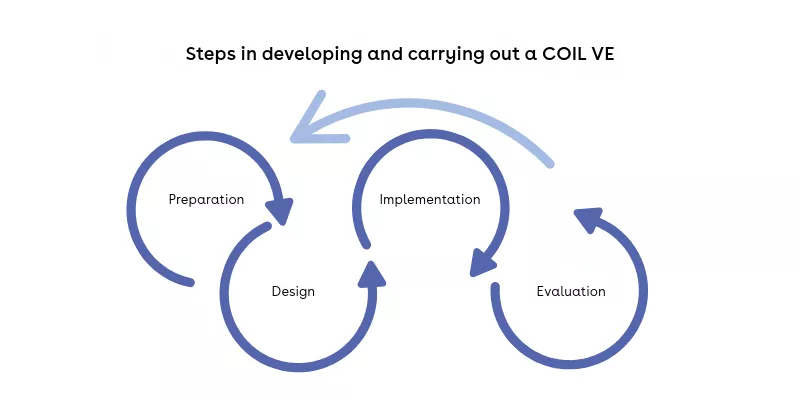
What are the steps involved in developing a COIL VE?
To explain these steps, we use sources specific to COIL VE design and practical experiences, as well as literature from educational science.
Sometimes this literature has no explicit focus on online collaborations and online teaching, but it does offer valuable insights into, among other things, constructive alignment and collaborative learning that we can use and 'rethink' so that they become applicable to the COIL VE context.
It is important to coordinate content, activities, deadlines and the use of online communication tools with your partner to ensure a successful learning experience for students (Kayumova & Sadykova, 2016).
Professional exchange and networking
In the Netherlands, COILectiVE NL brings together professionals working with COIL VE in vocational and higher education. The network facilitates the exchange of experiences, knowledge and good practices related to COIL VE and Internationalisation at Home.
Tips for collaboration in a COIL VE
Effective collaboration is at the heart of every COIL VE project. The tips below offer guidance to help institutions work together smoothly and create meaningful learning experiences.
Where to find COIL VE inspiration and resources?
Curious how institutions worldwide design their COIL VE collaborations? Explore the cases below. They illustrate what's possible and may inspire your own COIL VE initiative.
What COIL VE examples are there?
The following COIL VE examples from different educational settings can help you get started and spark new ideas.
Some more examples:
- In the Netherlands, COILectiVE NL brings together professionals working with COIL VE. The network encourages the exchange of experiences, knowledge and practice examples.
- The NVAO overview contains several inspiring case studies.
Do you have an inspiring example yourself? Let us know and email your story to iahho@nuffic.nl.
What do students think of COIL VE?
- In the Internationalisation at Home podcast, three university students talk about their experiences with COIL VE.
- Student Marlous is interviewed about her experiences with COIL VE by Jos Beelen, professor of Global Learning at THUAS.
- AUAS students reflect on their COIL VE experiences.
- Students from Italy, the Netherlands and South Africa share their experiences with COIL VE.
- International marketing students from Robert Gordon University (UK) share their experiences in this video.
- In the magazine of the Global Office of the Faculty of Management and Organisation at THUAS you will find various experiences of students (and lecturers) who reflect on their COIL VE adventures.
- In this short EAIE (European Association for International Education) article, student Anita reflects on her experiences with COIL VE and its impact on her personal and professional development.
- The e-learning module of AUAS on COIL VE contains a video about the experiences of a student during the project and the doubts and solutions this student encounters.
Where to find partners for a COIL VE?
You can find partners in your personal network, the network of your university or college, or through various organisations and platforms (Villard, 2023). Some colleges and universities provide a form on their website that colleagues interested in COIL VE can fill in to get in touch with their institution’s COIL VE coordinator or international office.
Having interested colleagues complete a questionnaire also serves as a way to monitor activities at a more central level, so that you can learn from each other internally and strengthen each other's expertise. See the example of the University of Durban.
On the website of the VIS support programme you will find an overview of various initiatives:
- Unicollaboration
- Stevens Initiative
- COIL connect (paid membership)
Do you work for a teacher training college and are you looking for partners in a European context? Then eTwinning might be something for you.
Additionally, all over the world there are regional networks of higher education institutions that collaborate in the field of COIL VE. Examples are the Latam COIL network and COIL Global Network – SUNY COIL Center (paid membership). Recently, a European VE-COIL hub was established in collaboration with Unicollaboration. To register, mail to EU-VE-HUB@list.nl.
Where to find COIL VE opportunities and networks?
Training courses on COIL VE
- COILectiVE NL is an emerging Dutch network for professionals working with COIL VE. It aims to facilitate knowledge exchange, inspiration and professional connections.
- Keep an eye on the EAIE agenda for live participation in online, paid training courses, for example on how to implement virtual exchange in the curriculum. You can also request in-house training courses on, for example, the assessment of international learning outcomes.
- Are you looking for a short e-learning module that will guide you quickly through the basics of COIL VE using an example? Check out the e-learning module developed by AUAS.
What subsidies are available for a COIL VE?
- In the Netherlands, the Ministry of Education, Culture and Science offered opportunities with the VIS subsidy scheme until 2024.
- Erasmus+ offers virtual exchanges for higher education.
Want to follow the latest trends and developments in COIL VE?
- Visit the annual IVEC conference, which is often hybrid (or at least in part).
- The annual EAIE conference offers the opportunity to meet colleagues and attend sessions on trends and developments around IaH (Internationalisation at Home) and specifically COIL VE. The EAIE website regularly features blogs on COIL VE, and as a member you can participate (for a fee) in various training courses.
- In the Netherlands, COILectiVE NL brings together professionals working with COIL VE in vocational and higher education. The network facilitates the exchange of experiences, knowledge and good practices related to COIL VE and Internationalisation at Home.
- If you would like to learn more about IaH and discuss it with colleagues, join our LinkedIn community.