Bridging Divides through Dialogue: Reflections on the EU-ASEAN Policy Dialogue on Higher Education
By: Norfatinafina Md Afandi, YSBEA
EU-ASEAN Policy Dialogue on Enhancing Talent and Skills Development through Internationalisation
Education is the bridge to sustainable development – and our dialogues help design that bridge. They are not ceremonial, but strategic – ensuring ASEAN and EU higher education can accelerate progress, not fall behind.

DR. FRANK FEULNER
Team Leader of SCOPE-HE
At the recent EU-ASEAN Policy Dialogue on Higher Education in Kuala Lumpur, which focused on enhancing talent and skills development through internationalisation, I had the privilege of once again taking part in this growing conversation. Having attended the previous dialogues in Vientiane and Brussels, I’ve witnessed how these spaces continue to evolve — from forums of exploration to dialogues of shared action. Each gathering feels like a chapter in an ongoing story: questions raised in one are revisited, refined, and reimagined in the next.
This third dialogue offered a slightly different experience. In Brussels, I had the honour of facilitating the youth-focused breakout group, while in Kuala Lumpur, I participated more as an attendee — engaging in discussions and breakout sessions from a reflective, listening standpoint. Though a less visible role, it was equally meaningful. It reminded me of the value of pausing to observe — of understanding how ideas once posed as questions are now being shaped into collaborative frameworks for the region.
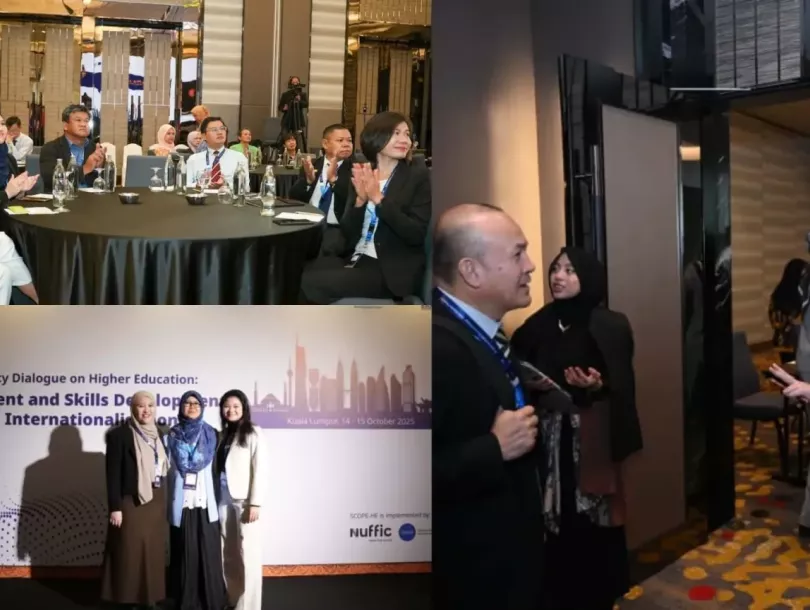
Photo collage showing Afina participating in the 3rd EU-ASEAN Policy Dialogue on Higher Education in Kuala Lumpur (14–15 October 2025). The images include conference participants seated and applauding, Afina in conversation with delegates in the hallway, and Afina posing with colleagues in front of the event backdrop)
Dr. Feulner’s words capture this reality well: the road ahead is long, and progress takes time. The need for a common, inclusive, and accessible space remains central — ensuring that no one is left behind. Dialogue continues to play a vital role in shaping that bridge, while education remains the bridge itself — connecting people, ideas, and opportunities across borders.
We are living in a multipolar world — one marked by both instability and opportunity. As divisions deepen, the urgency to connect grows stronger. Yet within that very complexity lies the potential to create more resilient, adaptive, and inclusive mechanisms for cooperation. In such times, people-to-people connectivity becomes more than a policy phrase — it becomes an act of resilience.
These dialogues remind us that education is not just a bridge between nations, but also between generations, sectors, and perspectives. Dialogue ensures that these bridges are not only built — but built to last, with no one left behind.
Doors Do Open: SCOPE-HE Internship Story
An intership story where you can also make an impact!
From Vientiane to Brussels: Youth Reflections on Higher Education Policy
Read another story by By Norfatinafina Md Afandi from YSBEA.
Empowering ASEAN’s Future Through Inclusive Higher Education
ASEAN Policy Forum on Higher Education 2024 in Vientiane, Lao PDR