International Students in the Netherlands 2026
Facts, figures, challenges and benefits
This page presents key facts and figures on international students in the Netherlands, such as total numbers, new enrolments, drop-out rates and retention, as well as information on the language of instruction at Dutch universities. We also summarise the challlenges and benefits associated with incoming student mobility in the Netherlands. At the bottom of the page, you will find suggestions for further reading and a list of sources cited.

Facts and figures
What do we mean by ‘international students’?
International students are students who do not hold Dutch nationality and who did not complete their secondary education in the Netherlands (CPB, 2026: 6). This means that ‘homecoming students’ (Dutch students who completed their secondary education abroad) are not counted as international.
International degree students complete their entire bachelor’s or master’s programme in the Netherlands. International students staying in the Netherlands temporarily for an exchange or internship as part of their studies abroad are thus not included (see Exchange students), nor are students in vocational education and training (VET).
Difference between EEA and non-EEA students
Students from the European Economic Area (EEA: all EU Member States plus Liechtenstein, Norway and Iceland) pay the statutory tuition fee rate in the Netherlands (€2,684 for 2026/27), which is subsidised by the Dutch government. In some cases, EEA students may be eligible for student finance, for example if they have been living in the Netherlands for more than five years or work more than 32 hours per month (DUO, 2025). Students from outside the EEA pay the higher institutional tuition fee rate. For bachelor’s programmes, average institutional tuition fees range from €9,000 to €20,000, and for master’s programmes from €12,000 to €30,000 (Study in NL, 2026). Students from outside the EEA also usually require a residence permit, under which they are allowed to work a limited number of hours (IND, 2025).
Total numbers
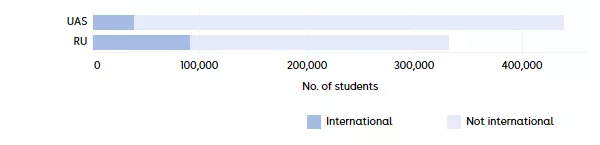
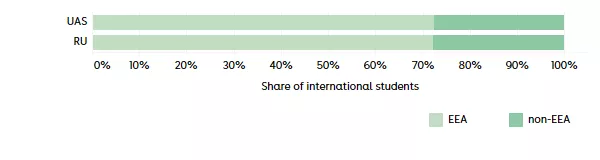
In the 2025-26 academic year, 129,764 international students were enrolled on a bachelor’s or master’s degree programme at publicly funded research universities and universities of applied sciences in the Netherlands. These international degree students accounted for 17% of the total student population. Of all students at research universities, 27% were international, compared with 9% at universities of applied sciences. Of all international students, 72% came from the EEA and 28% from outside the EEA.
What constitutes a new enrolment?
Statistics Netherlands (CBS), Universities of the Netherlands (UNL), the Association of Universities of Applied Sciences (VH) and Nuffic use different definitions for new enrolments. In Nuffic publications, we consider a student to be a new enrolment if they are enrolling for the first time in a specific combination of level of study (bachelor/master) and type of institution (university of applied sciences/research university), for example for a bachelor’s degree at a university of applied sciences or a master’s degree at a research university.
In the 2025-26 academic year, publicly funded universities received 48,139 new international enrolments for a full bachelor’s or master’s programme. Of this group, 69% (33,388) came from the EEA and 31% (14,694) from outside the EEA. Research universities accounted for 76% (36,660) of new international enrolments, of which 70% (25,687) were from the EEA and 30% (10,947) from outside the EEA. Universities of applied sciences received 11,479 new international enrolments, of which 67% (7,701) were from the EEA and 33% (3,747) from outside the EEA. For bachelor’s programmes, there were a total of 25,804 new international enrolments (71% EEA; 29% non-EEA), compared with 22,335 for master’s programmes (68% EEA; 32% non-EEA) (DUO 1cijferHO).
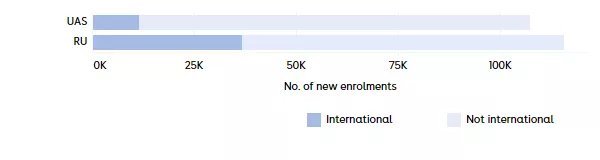
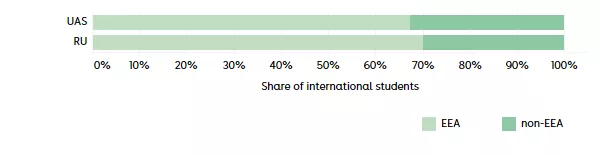
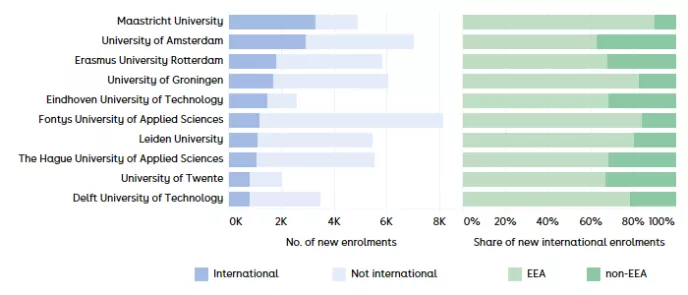
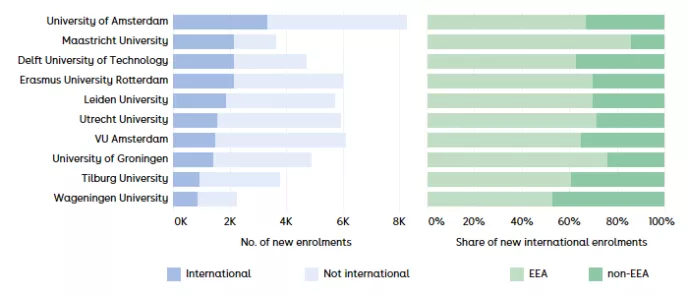
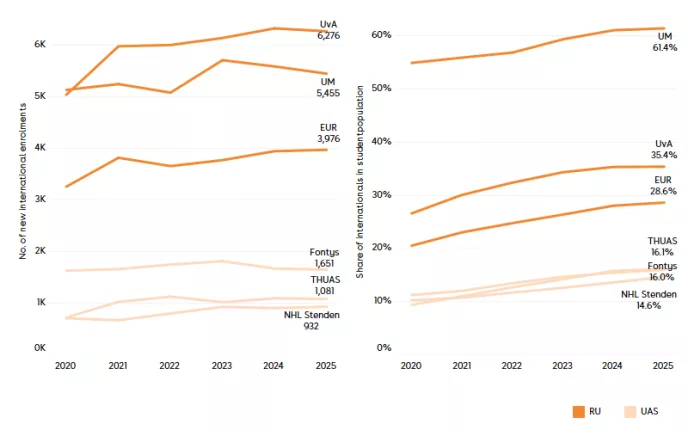
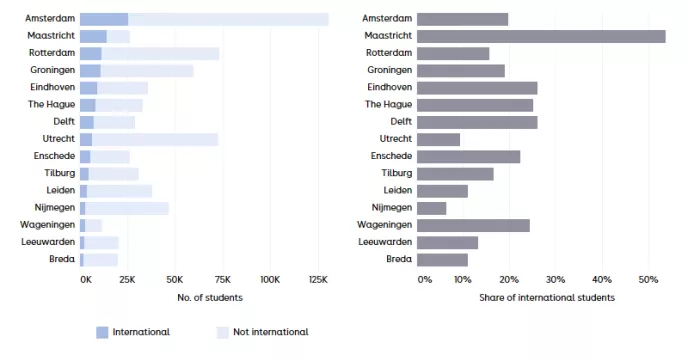
Table 1. Top 10 municipalities based on the number of new international enrolments in 2025-26
| Municipality | Number of new international enrolments | EEA | Non EEA |
| Amsterdam | 9,935 | 64.0% | 36.0% |
| Maastricht | 5,737 | 88.9% | 11.1% |
| Rotterdam | 5,013 | 66.3% | 33.7% |
| Groningen | 3,835 | 75.3% | 24.7% |
| Eindhoven | 3,244 | 62.4% | 37.6% |
| Delft | 3,067 | 64.8% | 35.2% |
| Utrecht | 2,865 | 67.6% | 32.4% |
| 's-Gravenhage | 2,701 | 76.1% | 23.9% |
| Tilburg | 1,987 | 64.5% | 35.5% |
| Enschede | 1,863 | 63.2% | 36.8% |
Growth and trends: new enrolments and total numbers
Research universities (RU)
New enrolments
At research universities, the number of new enrolments of international degree students fell by less than half a per cent in the academic year 2025-26. There were 110 fewer enrolments of international students in 2025-26 compared with 2024-25. The intake of Dutch students remained stable.
Total numbers
In 2025-26, the share of international degree students in the total student population was 27%, the same as in the previous year. Following years of slowing growth, the total number of international students fell for the first time by almost 1%. There were 647 fewer international students at research universities in 2025-26 compared with 2024-25.
Universities of applied sciences (UAS)
New enrolments
At universities of applied sciences too, the number of new enrolments of international degree students is in decline. The academic year 2025-26 saw a decrease of almost 1%, amounting to 70 fewer new international enrolments than the year before. This is, however, smaller than the 4% drop in 2024-25. The intake of Dutch UAS students in 2025-26 also fell slightly, by around half a per cent (573 fewer new Dutch enrolments).
Total numbers
In 2025-26, there were 514 more international degree students studying at universities of applied sciences compared with the year before, equivalent to an increase of about 1%. This represents slower growth than in previous years (3% growth in 2024-25; 4% in 2023-24). In 2025-26, 9% of all UAS students were international, roughly the same as the previous year.
Exchange students
In addition to degree students, there are also international students who undertake part of their studies or an internship in the Netherlands. No comprehensive figures are available on the size of this group. We do know, however, that in the academic year 2024-25, there were 16,621 incoming students with an Erasmus+ grant. This is slightly more than in 2023-24, when there were 16,419 incoming Erasmus+ students. Of the incoming students in 2024-25, the majority (12,391; 75%) came to the Netherlands to study; the remaining 4,230 students (26%) undertook an internship. The main countries of origin for these incoming Erasmus+ students were Spain (2,493 students), France (2,327) and Germany (2,155).
For comparison, in the same academic year (2024-25), 18,785 Dutch students went abroad on an Erasmus+ grant. Of the outgoing students, 13,913 (74%) went abroad to study and 4,872 (26%) for an internship. The most popular destination countries were Spain (3,758 students), Italy (1,658) and Germany (1,498) (European Commission, 2026).
Academic success of international students
Of the international students who commence a research university bachelor’s programme, just over two-thirds (69%) have obtained a degree after four years. Among Dutch students, this figure stands at 62%. At universities of applied sciences, 58% of international students and 50% of Dutch students obtain their bachelor’s degree after four years (DUO, 2026). Compared with Dutch students, however, international students at research universities are more likely to drop out of their degree programme during the first year. Of international first-year RU students, 12% drop out, compared with 3% of Dutch first-year students.
Programmes taught in a foreign language
Research universities
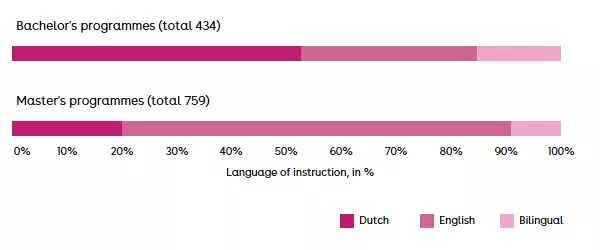
Most RU bachelor’s programmes are taught entirely in Dutch. According to the most recent data, in 2025-26 just over half (53%) of the 434 unique bachelor’s programmes at Dutch research universities were taught in Dutch (UNL, 2026). The proportion of English-taught bachelor’s programmes was 32%. The remaining 15% were taught in both English and Dutch. Only the Interdisciplinary and Engineering fields of study delivered the majority of their bachelor’s programmes in English. The other fields of study were predominantly taught in Dutch (UNL, 2026).
The most used language of instruction for master’s programmes is English. Of the 759 RU master’s programmes, 71% were offered exclusively in English, compared with 20% exclusively in Dutch. Of all RU master’s programmes, 9% were taught in both languages. English was the most common language of instruction in all fields of study, except for Law and Education. Master’s programmes in the field of Agriculture & Natural Environment were taught exclusively in English (UNL, 2026).
Universities of applied sciences
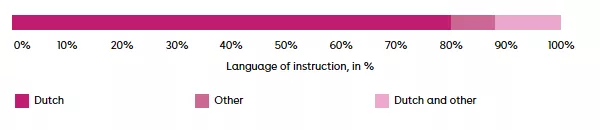
In 2024, the Association of Universities of Applied Sciences reported that, in the academic year 2023-24, 92% of bachelor’s programmes were taught in Dutch and 80% were taught exclusively in Dutch. Of the UAS bachelor’s programmes, 8% were taught exclusively in a foreign language. Eight of the 36 universities of applied sciences in the Netherlands offered programmes exclusively in Dutch in 2023-24 (VH, 2024). No data are available on the language of instruction for UAS master’s programmes.
Dutch students abroad
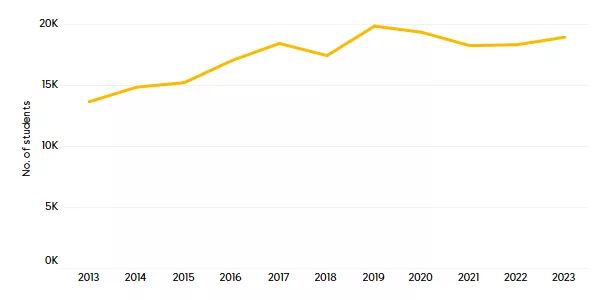
The number of students from the Netherlands studying abroad is much smaller than the number of international degree students coming to the Netherlands, but it is growing. According to the most recent data from UNESCO, 18,922 Dutch students pursued a full bachelor’s or master’s degree abroad in 2022-23. This is 39% more than 10 years earlier (13,646 in 2012-13; Nuffic, 2024a). Nevertheless, the proportion of all Dutch students obtaining their degree abroad remains relatively low: approximately 3% in 2022-23. The EU average is 4% (European Commission, 2025).
Challenges and benefits


Further reading and references
- In this document you can find an overview of current literature: Further reading;
- In this document you can find a list of sources cited: Reference list.
Compiled by

Clara Eggenhuizen
Researcher
Celine Pronk
Researcher

Saoradh Favier
Programma Coordinator Mobility