How many international students study at a Dutch university of applied sciences or research university in 2024-25? Where do they come from, and how does the number of new enrolments compare to previous years? In this annual report, we present the latest figures on incoming degree mobility in Dutch higher education, based on data from DUO, the Dutch Education Executive Agency. We examine differences between bachelor's and master's programmes, types of institutions, and fields of study, as well as the extent to which the student population in the Netherlands is international.
Lowest growth in 10 years
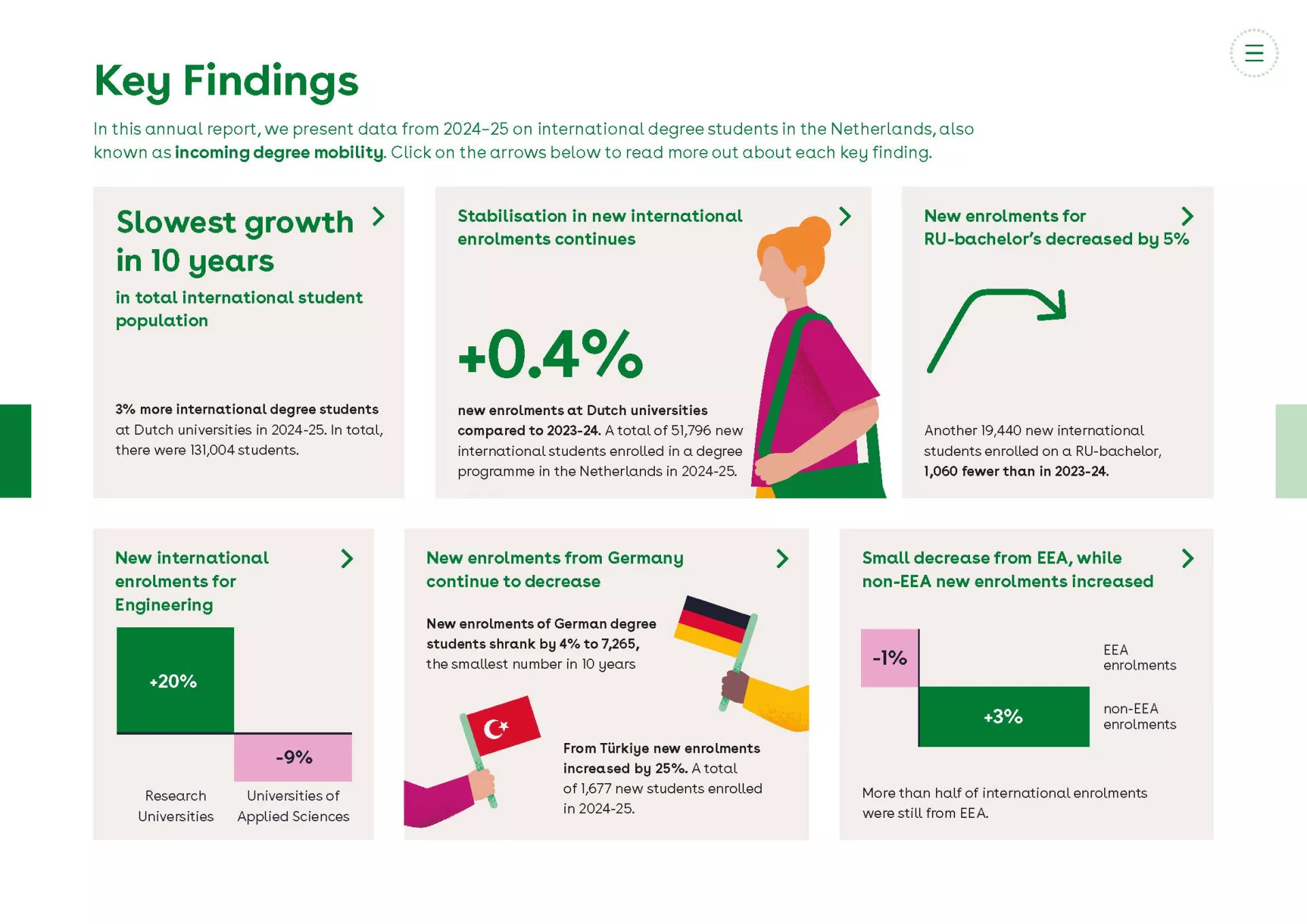
In 2024-25, a total of 131,004 international degree students study at a Dutch university of applied sciences or research university, 3% more than in 2023-24 (+3,835). This is the lowest growth in 10 years.
International bachelor enrolments decline, master enrolments increase
In 2024-25, fewer international students enrol in bachelor's programmes. At the same time, the numbers at master’s level grow, mainly because international students already studying in the Netherlands continue into a master's programme. As a result, the total number of new international enrolments remains almost unchanged compared to last year (+0.4%). This is the smallest annual growth since 2007–08.
Fewer new enrolments from the EEA, more from outside the EEA
In 2024-25, the number of new enrolments from EEA countries falls slightly, despite the reintroduction of the basic student grant, for which EEA students are eligible under certain conditions. At the same time, the number of new enrolments from outside the EEA grows, although their share remains considerably smaller than that of EEA students.
Fewest new enrolments from Germany in 10 years; Turkey rises by 25%
In 2024-25, 7,265 German students enrol at a university of applied sciences or research university in the Netherlands – the lowest number in 10 years. This means that the total number of German degree students in the Netherlands falls below 20,000 for the first time since 2008-09. In contrast, new enrolments from Turkey are rising sharply: there are 1,677 new enrolments, which is 25% more than last year.
Engineering: increase and decrease
International enrolment in Engineering at research universities is growing significantly, especially at TU Eindhoven and TU Delft. In contrast, universities of applied sciences are experiencing a decline in new international Engineering students.
Download the PDF for more insights into international enrolment and the total number of international students, including breakdowns by type of education. This report also contains information about current developments that provide context for the figures.
To read more on this topic:
Dashboards for additional information, such as data on specific countries of origin and fields of study: https://www.nuffic.nl/en/research-facts-and-figures/interactive-dashboards