English is a key factor when choosing to study in the Netherlands
International bachelor’s students are drawn to the Netherlands primarily by the widespread use of English, both inside and outside the classroom. However, more than 7 in 10 still express concerns about the ongoing housing shortage, according to our newest research that explores this decision-making process. Read the full analysis.

While the motivations behind studying abroad have been extensively researched, far less is known about why students choose a specific destination country. To fill this gap, Nuffic investigated what drives international students to pursue their bachelor’s degree in the Netherlands.
"There is a wealth of literature on the motivation to study abroad," says Nuffic researcher Ece Arat. "But we know much less about why students choose country A over country B."

A multifaceted decision-making process
For 4 out of 5 respondents (80.1 percent), the Netherlands was their top choice, though most also explored alternatives during their search. The final decision is typically a complex, highly personal process shaped by a mix of individual preferences, family advice, personal ties, and unique personal circumstances.
"We noticed that students constantly weigh different countries against one another; it is rarely a straightforward choice,” Arat explains. “For instance, many considered studying in the United States but were discouraged by their parents, who felt it was too far away or unsafe. For others, having family already living in the Netherlands was a deciding factor."
Brexit is also impacting this decision-making process. While the United Kingdom remains the most frequently mentioned alternative to the US, skyrocketing tuition fees and complex visa procedures ultimately push students toward the Netherlands. "Students told us that, post-Brexit, the Netherlands has become the premier choice if you want to study in English," Arat says.
“Being able to use English both on campus and off campus was the deciding factor for many students.”

ECE ARAT
Researcher at Nuffic
English on and off campus
English is the primary driver behind the decision to study in the Netherlands. Nearly 9 in 10 respondents (89.7 percent) cite the wide availability of English-taught programmes as (very) important. The widespread use of English in daily life scores almost as highly at 87.1 percent. "I found that to be a fascinating observation," Arat notes. “It is not just about your studies, but also about your life outside of them."
The report shows that this is precisely where bachelor's students face a pitfall. Once they arrive, the Dutch language proves to be far more critical than expected, particularly for socialising and securing a part-time job. "Students indicated that they had seriously underestimated the importance of the Dutch language," Arat says.
Balancing quality and cost
The Netherlands is widely recognized for combining high-quality education with relatively affordable tuition fees. More than 8 in 10 students (82.8 percent) consider affordable tuition a key factor. Meanwhile, programme quality and rankings are important to 80.5 percent of respondents, while quality of life appeals to 86.1 percent.
Career prospects also influence the choice of where to pursue a bachelor’s degree. However, students look primarily at opportunities in the international labour market (78.1 percent), rather than those within the Netherlands (67.9 percent). "That surprised us," Arat says. "Bachelor's students are not yet focused on concrete plans for life after graduation. Their main thought is: 'The Netherlands has a good reputation, which looks great on my CV.' For master's students, we would likely see different results."
“We have plenty of affordable rooms for international students. The housing shortage is much less severe here.”

PIETER-BART VISSCHER
Manager at HZ Nexus
In Zeeland, accommodation is a major plus
The student housing shortage is not felt equally everywhere. At HZ University of Applied Sciences in Zeeland, the issue is practically non-existent. Out of more than 4,100 full-time students, 831 are international, hailing from 86 countries. They are primarily enrolled in the university's nine (partly) English-taught degree programmes, which range from Water Management and Chemistry to International Business.
"Housing shortages are far less of a concern here," says Pieter-Bart Visscher, manager at HZ Nexus. "In fact, the availability of student accommodation is a key reason why students choose Zeeland. On top of that, many are drawn to the relative tranquility that the region offers."
International students vital for a region facing population decline
International students are crucial for a region like Zeeland, Visscher points out. “Demographically, the number of school leavers in Zeeland is shrinking,” the HZ Nexus manager explains. “Relying solely on domestic enrollment makes it difficult to sustain our degree programmes—and, ultimately, to keep the regional workforce fully staffed.” Consequently, international students provide a vital lifeline.
Visscher notes that the region offers abundant employment opportunities. "We boast a major logistics and chemical cluster, we are actively tackling energy transition challenges, and we are strategically located between three of Europe’s largest seaports," he says. "This creates plenty of career prospects, particularly for international talent."
Positive impression, structural bottlenecks
According to the report, just over three-quarters of students (77.5 percent) feel their experience pursuing a bachelor’s degree in the Netherlands has lived up to their expectations. The quality of education, safety, and the international environment received particularly high marks.
However, many bachelor's students were surprised by the distinction between universities of applied sciences (hbo) and research universities (wo). Just over 4 in 10 (40.1 percent) did not fully understand what this difference entailed when they applied. "This binary system does not exist in every country," Arat explains. "Students enroll at a university of applied sciences, only to discover later that it is not always perceived as a traditional university. For some, that comes as a disappointment."
"Using English is convenient, though it comes with a downside"
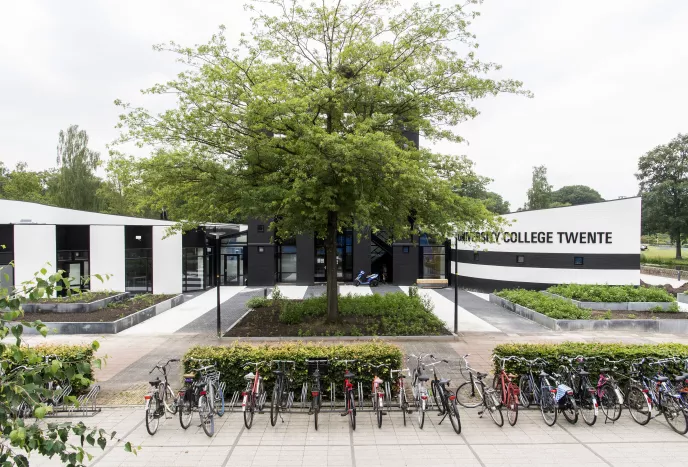
Ceyda Çelebi (from Izmir, Turkey) graduated in June from ATLAS, the University College of the University of Twente. "I weighed my options across various universities. Factors such as the cost of living, teaching styles, geographical distance, and social life all played a part in my decision." Ceyda ultimately chose the Netherlands primarily because of the ATLAS programme's structure and its vibrant student life. “The student life and the opportunities at the University of Twente really appealed to me.”
Like many interviewed students, she appreciated being able to get by in English almost everywhere. "Still, there is a downside. It is great for international students not having to learn Dutch right away. That helps at the start, but learning the local language aids in societal integration and is always a valuable bonus."
Ceyda was also surprised by how little weight people in the Netherlands place on university rankings. "In Turkey, your university's reputation is the first thing people look at, especially for engineering degrees," she says. "Here, I noticed that people hardly care which university you attend because the quality of education is high everywhere. Delft, Eindhoven, and Twente are all strong technical universities, each with its own specializations." Following the summer, Ceyda is pursuing a master’s degree in Civil Engineering at the University of Twente.
- Download the full report: Why pursue a bachelor's degree in the Netherlands?
- Join our webinar about this research and our findings on September 16, 2026;
- Check our interactive dashboards for additional information, such as data on specific countries of origin and fields of study.
Images: Marit Hazebroek and Frans Nikkels (University of Twente)