Balancing People, Planet, and Prosperity
Stories from the Higher Education Partnership for a Sustainable Blue Economy by Inty Dienasari

"It's really important to look at what people want, what the economy needs, and also not forget ecosystem health."
That simple idea is what first drew Kai Nijhuis to the Summer School in Indonesia.
As a Master's student in Marine Biology at the University of Groningen, Kai has spent much of his academic journey studying marine protected areas and biodiversity conservation. Yet, for him, protecting nature has never been only about ecosystems. It is also about understanding the people who depend on them and finding solutions that work for society as a whole.
The opportunity to explore those different perspectives came through the Summer School, themed Building Resilience Highland to Ocean (H2O): The Role of Nature-Based Solutions in Supporting a Sustainable Blue Economy. Organised under the Higher Education Partnership for a Sustainable Blue Economy (STABLE), one of the Higher Education Institution (HEI) Clusters supported through SCOPE-HE, the EU–ASEAN Sustainable Connectivity Package – Higher Education Programme, the Summer School brings together students, researchers and academics from Europe and Southeast Asia to exchange knowledge and strengthen collaboration under the European Union's Global Gateway strategy.
Learning How a Blue Economy Is Built
Before coming to Indonesia, Kai's studies had largely focused on marine systems where policies and management frameworks were already well established. What surprised him most during the Summer School was the opportunity to understand what happens long before those systems are in place.
"In Groningen, we mostly learn about a Blue Economy when it's already established," he says. "Here, they showed us the process of establishing one."
For Kai, this offered a perspective he had not encountered before.
"I hadn't really heard about the challenges of making policies, getting funding, or deciding how marine protected areas should be organised," he explains. "I like that they tell us about the process because I missed that a bit in my education."
Rather than focusing only on the end result, the programme exposed participants to the complex decisions behind building a sustainable Blue Economy—from governance and financing to marine spatial planning and stakeholder engagement.

Participants from different countries, including Kai Nijhuis, take part in a team-building exercise during the opening session of the H2O Summer Course, fostering trust, collaboration, and cross-cultural friendships from the very first day.
Beyond Science Alone
The experience also encouraged Kai to reflect on his own role as a future scientist.
"As a scientist, I mostly think, 'I want to preserve nature—that's my main goal,'" he says. "But sometimes you can get tunnel vision as a scientist on what you want, and not on what the whole society wants."
Instead, he believes sustainable solutions can only emerge when different perspectives are brought together.
"I think it's really important that you communicate and involve everyone," he says. "Fishermen can give scientists information that scientists can use for research, while scientists can share knowledge that benefits communities in the long term."
For Kai, that shift in perspective may become one of the programme's most valuable outcomes—not simply learning more about marine science, but recognising that science alone cannot build a sustainable Blue Economy.
From Classroom to the Field
Another aspect Kai appreciated was the opportunity to connect classroom discussions with real-world practice.
"We've had some information during the lectures, but I think it's really nice to see it in person as well," he says. "Someone can say it, but when you actually see it, it speaks more to you."
One of the field visits particularly caught his attention after participants discussed the environmental pressures facing intensive aquaculture.
"I'm really interested to know what they're going to do about those problems with regards to the lakes and the healthiness of those lakes," he says.
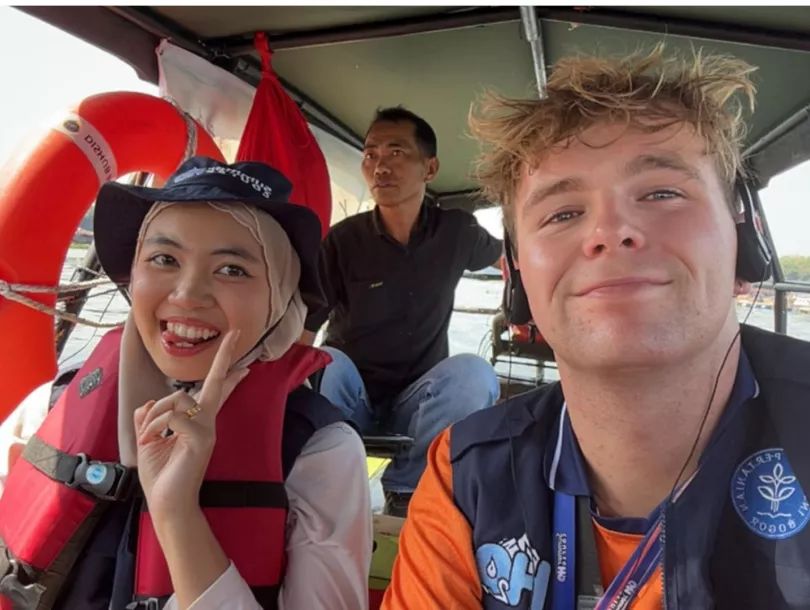
As part of the H2O Summer Course field excursion, Kai Nijhuis and Muna from Universiti Malaysia Terengganu (UMT) visit the open-water fish cages at Cirata Reservoir to learn about sustainable aquaculture and the management of freshwater ecosystems.
Looking Ahead
While Kai hopes to pursue a PhD, he is equally open to a future that bridges science and public policy.
"I would also not mind going into policy," he says. "It's interesting to bring together economy, society and science, and combine those three to make sure we have healthy ecosystems, healthy people and a healthy economy."
For Kai, the Summer School offered more than new knowledge. It broadened his understanding of the people, partnerships and processes needed to build a sustainable Blue Economy. Learning alongside participants from Europe and Southeast Asia also reinforced the value of exchanging perspectives across borders—an experience he hopes to carry into his future career, whether in research, policy or both.
About the Programme
The Higher Education Partnership for a Sustainable Blue Economy (STABLE) is one of the Higher Education Institution (HEI) Clusters supported through SCOPE-HE, the EU–ASEAN Sustainable Connectivity Package – Higher Education.
Supported by the European Union under the Global Gateway initiative, SCOPE-HE strengthens collaboration between higher education institutions across Europe and Southeast Asia. Through STABLE, students, researchers and academics work together to advance education, research and innovation for a sustainable Blue Economy.
Read more about STABLE: https://scopehe-stable.ipb.ac.id/