Learning beyond Borders
A study on the international experience (credit mobility and digital international collaboration) of higher education graduates from 2020–2022. We examined who participated, how accessible an international experience was, why graduates took part, and where they went. We also explored what graduates learned from an international experience and what the benefits were on the labour market.
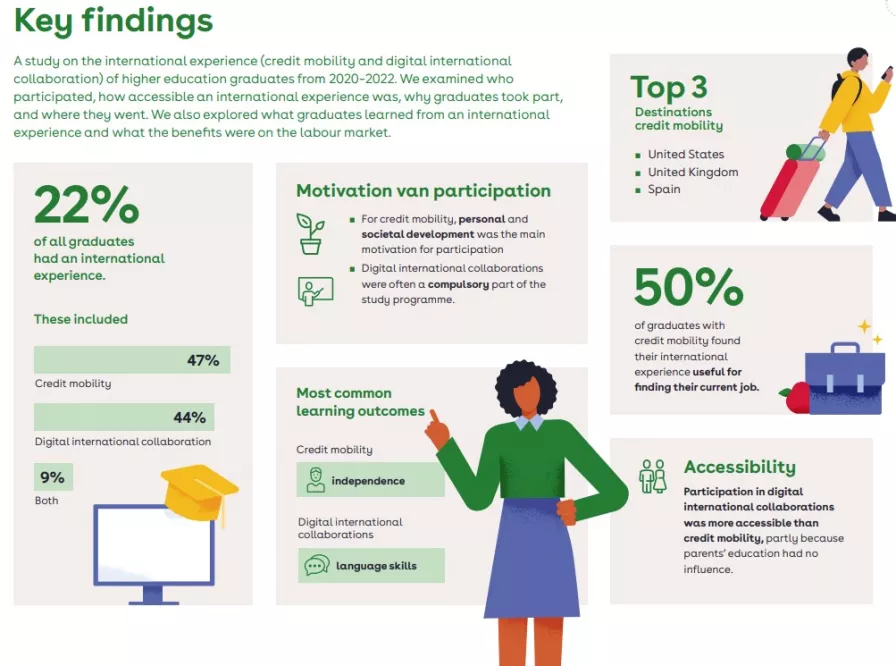
How do Dutch students gain international experience? What motivates them and what international competences do they develop as a result? In the report Learning Beyond Borders, we answer these questions and more. We based our findings on a survey conducted by Statistics Netherlands (CBS) among more than 15,000 graduates in the period 2020-22.
We examined two ways in which students gain international experience:
• Credit mobility: students go abroad for part of their studies or internship
• Digital International Collaboration (DIC): students collaborate online on a project with students from a foreign educational institution
22% of graduates had one of these international experiences. Of these, 47% went abroad and 44% participated in a digital project. 9% did both.
Who participates?
University of applied sciences (UAS) bachelor's students were most likely to have had an international experience (27%), followed by research university (RU) master's students (18%), RU bachelor's students (18%) and UAS master's students (15%). Students in the field of Services participated most often (39%), while students in the field of Education participated least often (13%).
DIC seems to be more accessible than credit mobility: characteristics such as field of study and parents' educational level play less of a role. However, these digital international experiences are more often a mandatory part of the study programme than credit mobility.
Why (not) participate?
Graduates who participated in an international activity did so primarily for personal or societal development (96% for credit mobility, 66% for DIC). An international experience, in both forms, was more often a mandatory part of the study programme at universities of applied sciences than at research universities.
Of the students who did not go abroad, almost half had considered doing so. The most frequently cited obstacles for this group were Covid-19, financial reasons, and obligations in the Netherlands.
What are the benefits of an international experience?
The most frequently mentioned learning outcome for credit mobility was independence. For DIC, it was language skills. For both forms, general and specific knowledge of cultures was also frequently mentioned as a learning outcome.
Half of the graduates with credit mobility found their experience abroad useful in finding their current job.
Questions?
Email us at research@nuffic.nl