Research: Europe now the most popular destination for international students
Over 1.2 million students from the rest of the world study in Europe. This is according to new European research, led by Nuffic. Marco Schouten, Managing Director of Nuffic: “The Netherlands can learn a great deal from this research.”

For the purposes of this research, ‘Europe’ refers to the European Union plus Iceland, Liechtenstein, North Macedonia, Norway, Serbia and Turkey. Together, these countries form the so-called ‘Study in Europe’ region. Students coming to this region from outside it, are referred to in this context as ‘international students’.
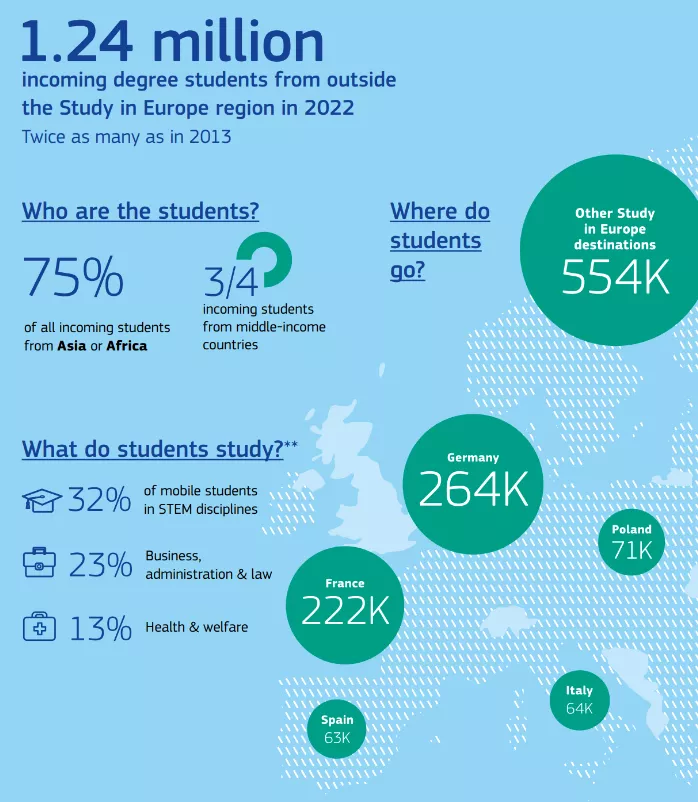
The number of international students in Europe more than doubled between 2013 and 2022. In 2019, Europe overtook the United States as the most popular destination among students from outside Europe. In 2022, 1.24 million international students were studying in the ‘Study in Europe’ region; approximately half of this group came from Asia. “Within Europe, Germany, Turkey, France, Poland and Spain are the most frequently chosen destinations”.
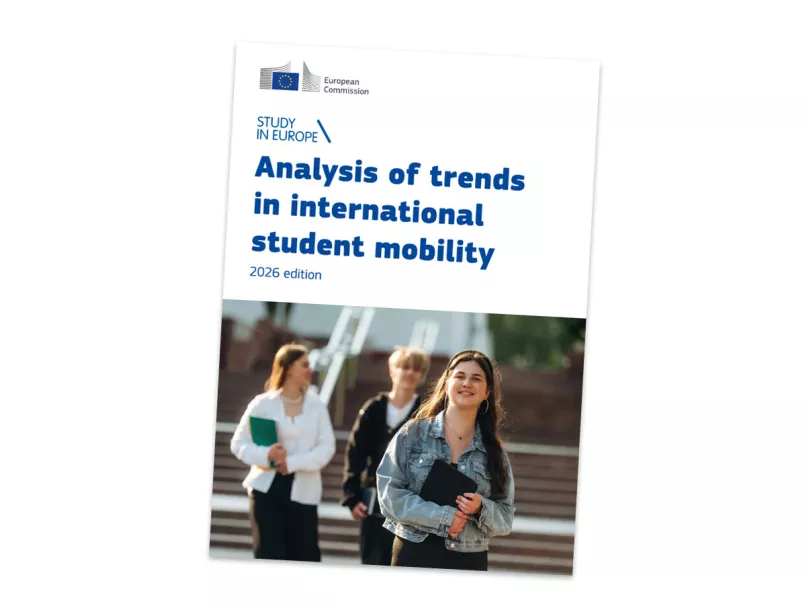
These figures are taken from the new report ‘Study in Europe. Analysis of trends in international student mobility’. Nuffic carried out the research on behalf of the European Commission, as part of the Study in Europe initiative, with support from Campus France (France) and ACA (Belgium).
Download the research report ‘Study in Europe. Analysis of trends in international student mobility’.
More students to Europe
“Everyone knew that more and more students were coming to Europe, but now, for the first time, we have hard figures,” says Marco Schouten, who has been Managing Director at Nuffic since 2025. “We are seeing significant growth and a shift in international student flows. For years, students mainly chose English-speaking destinations such as the United Kingdom, the United States, Canada and Australia. That is really changing. There has been a significant increase in the number of students going to non-English-speaking countries, particularly to European countries.”
This development is in line with the European Commission’s Union of Skills strategy. Europe needs international talent to tackle labour market shortages and boost innovation. That is why the Commission wants 350,000 international students to graduate in the EU each year from 2030 onwards. That figure currently stands at 250,000. These ambitions are in line with the EU’s aim to strengthen its own competitive position.
The aim of the study was therefore to provide an overview of European competitiveness. It has succeeded in doing so. Schouten is proud that Nuffic was able to lead this European study. “As a strong and independent research institute, we have the data and expertise to analyse ten years of student mobility. This makes this report incredibly relevant for policymakers – not only within the EU, but also within national governments and educational institutions.”
“Armed with this research, the Netherlands can see how this issue is developing elsewhere in Europe. What actions are other countries taking? What works and what doesn’t?”

MARCO SCHOUTEN
directeur-bestuurder Nuffic
The Netherlands put into perspective
The great thing about the study, according to the director-general, is that it places the Netherlands’ position in a broader perspective. “In the debate about the number of international students in the Netherlands, the focus is often on what national policy should be pursued,” says Schouten. “Yet the international context also influences our intake. Countries such as France and Germany are offering more and more English-language education, which is leading to increased competition for international talent. We need to be mindful of that.”
Technical degree programmes are popular
The study also paints a clear picture of the degree programmes that mobile students are pursuing in the European Union, based on a different dataset. This shows that a third of international students from Europe and beyond are studying a technical degree programme in Europe. “This is relevant for the Netherlands, as this is one of our sectors facing a skills shortage. Policymakers can then act on this, for example by taking measures to increase the likelihood of students staying. The greater that likelihood, the more our society and our economy benefit from international students and graduates.”
Schouten therefore sees the research as fitting seamlessly with the talent strategy the government is working on. “Armed with this research, the Netherlands can see how this issue is developing elsewhere in Europe. What actions are other countries taking? What works and what doesn’t? For example, you can see the impact that visa policy can have. In 2024, Canada imposed a cap on new study permits, and subsequently the intake of international students plummeted by almost 40 per cent.”
A European perspective on developments
Most of the research carried out by Nuffic focuses on the Dutch context. “This research broadens our own perspective,” says Schouten. “We are now learning how research is carried out in other European countries. And how the Germans, for example, deal with issues such as increasing the likelihood of students staying on.”
Although Nuffic’s primary focus remains on the Netherlands, Schouten expects that Nuffic will carry out more European research in the long term. “We have a wealth of knowledge and data in-house. Nuffic is made up of thinkers and doers. The great thing is that we don’t share opinions, but facts that policymakers and educational institutions can use to their advantage. The need for a European perspective on developments is growing. We are proud that, as Nuffic, we are able to contribute to this.”
Download the research report ‘Study in Europe. Analysis of trends in international student mobility’.
Find out more about why international students do or do not choose to stay and work in the Netherlands
Read more about the Study in Europe initiative on the website of the European Commission.