Mapping stakeholders
How Internationalisation at Home requires collaboration at multiple levels
How do you ensure that Internationalisation at Home is embedded in your educational institution? An exploratory study shows which stakeholders are involved in Vocational Education, Universities of Applied Sciences and Research Universities in the Netherlands – and how their roles and positions can vary greatly. Understanding this diversity helps with the targeted and systemic implementation of IaH.
In this article we use Vocational Education to refer to the Dutch ‘Middelbaar Beroepsonderwijs’. Universities of Applied Sciences and Research Universities are both considered part of the higher education sector in the Netherlands, referred to as hbo and wo respectively. Hbo institutions, or Universities of Applied Sciences, are more practice-oriented than wo institutions (Research Universities).
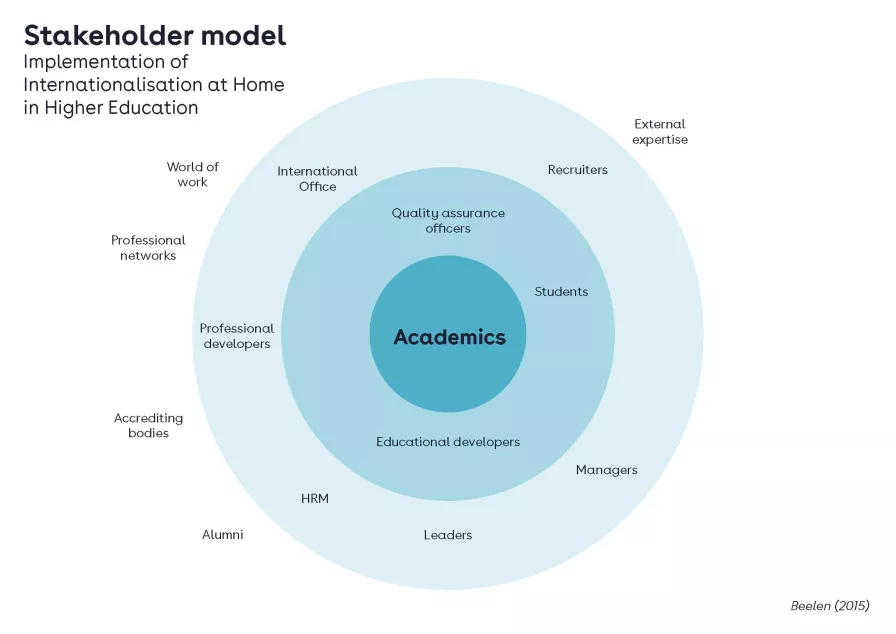
In recent years, there has been increasing attention for Internationalisation at Home (IaH) in Vocational Education and Higher Education. With IaH, all students acquire international competencies because these are integrated into the existing curriculum (Beelen & Jones, 2015). To gain a better understanding of the dynamics between internal and external stakeholders in Vocational Education, Universities of Applied Sciences, and Research Universities, The Hague University of Applied Sciences and Nuffic conducted an exploratory study. The researchers were interested in the differences between educational contexts. They also explored how the stakeholder model for IaH, developed by Jos Beelen (2015), professor in Global Learning at The Hague University of Applied Sciences, could be used by Internationalisation practitioners.
Different roles and interpretations
The respondents held a variety of roles within IaH. In Vocational Education, they were mostly internationalisation coordinators in direct contact with teaching staff. In Universities of Applied Sciences, the researchers mainly spoke with policy advisors and policy officers for internationalisation. Research University respondents were more diverse, including lecturers, policy advisors, and internationalisation coordinators. At these universities, IaH is often linked to broader themes such as diversity and inclusion. This variety highlights how context specific IaH is. However, one clear commonality,is that colleagues with a (formal) role in IaH typically work across the entire institution, connecting multiple layers and departments.
Although most respondents were familiar with the terminology of IaH, interpretations varied. A few of them noted that the definition by Jos Beelen and Elsbeth Jones (2015) is too academic. Others found it too static, as it does not capture the dynamics between stakeholders. In Vocational Education, IaH is sometimes associated with physical mobility, although this is not seen as the primary goal. At Research Universities, the focus is more often on the international classroom, Collaborative Online International Learning (COIL), or Virtual Exchange (VE).
The way IaH is embedded within institutions also varies. Sometimes respondents’ roles develop organically, while in other cases they are formal positions, such as IaH coordinator. Roles can be organised centrally or decentrally, and faculties, domains, colleges, and programmes have different degrees of policy autonomy. Some take no action on IaH despite the institutional vision, while others develop their own policies without the presence of an institution-wide framework.
Mapping stakeholders
The exploratory study shows that a variety of stakeholders are involved in IaH, but their roles and influence on the internationalisation of the curriculum differ. There are also a number of sector-specific stakeholders. Below, we highlight three examples of the findings. For more results and a visual overview, see our explorative study.
- Not every institution has an internationalisation coordinator, but there is often an international office. The extent to which the international office is mentioned as a stakeholder varies, as IaH is not always included in their job description. This can be explained by the fact that the international office often has less influence on the curriculum.
- Educational advisors are mentioned across all education sectors, although this collaboration requires more attention. Most respondents only identified this stakeholder when triggered by the IaH stakeholder model (Beelen, 2015).
- In vocational education, it was noted that the HRM department is a stakeholder to involve more in IaH for example by including the topic in staff appraisal cycles. In higher education, the answers were more varied as to which stakeholders should be more involved in the future. For instance, it was suggested that it is important to explore how IaH can be linked to European University Alliances and their partners.
The stakeholders can roughly be clustered into three groups: educational management, teaching teams (such as lecturers and educational advisors), and colleagues with specific expertise in internationalisation. This again highlights the diversity of IaH and how it spans different levels of an organisation and various disciplines. Connecting these colleagues in IaH is therefore crucial.
Context-specific and systematic approach
The exploratory study shows that IaH is organised in a variety of ways within educational institutions. Which stakeholders play a role, or should play a role, is highly context specific. At the same time, it is clear that stakeholders are present at all levels of educational institutions. Effective stakeholder management therefore requires the ability to navigate between these different layers. Building connections between stakeholders contributes to a more coherent and systemic approach to IaH within your institution.
The IaH stakeholder model has proven to be a valuable tool in practice. By visually mapping stakeholders, it provides an insight into who should be involved. In addition to the insights gained from the study, the researchers noted that the exercise for using the model was particularly appreciated by respondents. The steps from the interviews can be used as a discussion tool within teams, prompting reflection on one’s own situation. As Jolanda van de Lagemaat (Da Vinci College) explains: 'The stakeholder model is highly applicable for teams looking to work on Internationalisation at Home. It can serve as a reflective tool: what are we struggling with, why, and with whom can we make this happen?
We have gathered our insights in a publication in: Stakeholders in Internationalisation at Home.
We have also developed two toolkits to help you map your stakeholders in IaH.
The steps in the toolkits are based on the interview guide used in the explorative study.
Do you want to know more about IaH?
- If you are working at a Dutch education institute, join our LinkedIn groups: for Vocational Education, mbo, and higher education
- Have a look at our website.
- How can you adjust your communication style per stakeholder? The stakeholdermatrix made by The University of Applied Sciences in Amsterdam, VIVES University of Applied Sciences (Belgium) and Nuffic, might get you started in your situation.
- Do you want to get in touch with the research team (The Hague University of Applied Sciences and Nuffic) about stakeholder management in IaH? Feel free to reach out via mbo@nuffic.nl and iahho@nuffic.nl.