Everything Is Connected
Stories from the Higher Education Partnership for a Sustainable Blue Economy by Inty Dienasari

For Rozemarijn de Wit, joining the Summer School in Indonesia was about more than learning new scientific concepts. It was an opportunity to broaden her perspective by exploring how science, policy and local communities come together to shape a sustainable Blue Economy.
Beyond Science
As a second-year Master's student in Marine Biology at the University of Groningen, Rozemarijn has spent much of her academic journey studying marine ecosystems—from Arctic Ocean climate models to sediment dynamics in the Wadden Sea and the impacts of climate change on marine species. While her studies had provided a strong scientific foundation, Rozemarijn was looking for an opportunity to broaden her perspective through an international learning experience.
When applying for the Summer Course, she wrote that although her studies had provided a strong scientific foundation, she saw the programme as an opportunity to broaden her perspective through an international learning experience and to explore the socio-economic dimensions of marine biology.
That opportunity came through the Summer Course, themed Building Resilience Highland to Ocean (H2O): The Role of Nature-Based Solutions in Supporting a Sustainable Blue Economy, organised under the Higher Education Partnership for a Sustainable Blue Economy project (STABLE) as part of the EU–ASEAN Sustainable Connectivity Package – Higher Education (SCOPE-HE), an initiative supported by the European Union's Global Gateway strategy.
"My master's programme is very research-focused and very scientific," Rozemarijn says. "It was really interesting to get a new perspective on the policy and government side, because they have to work together."
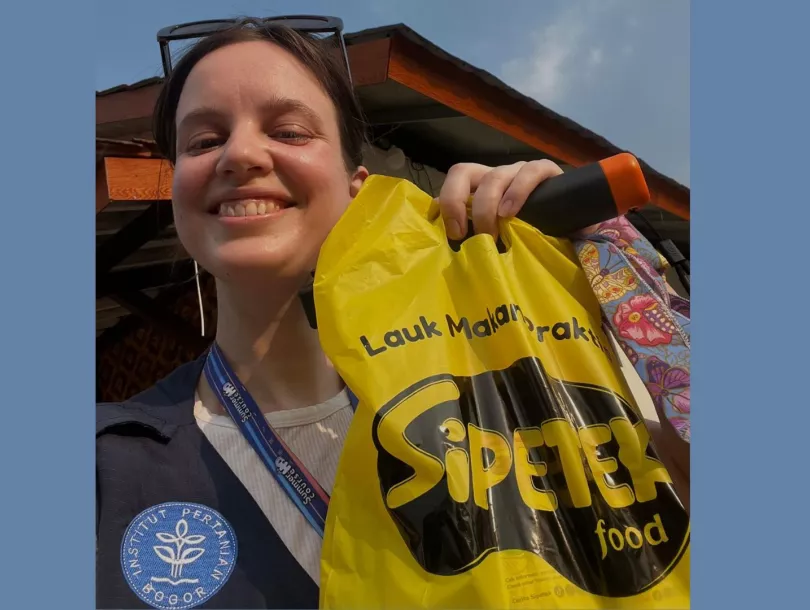
Beyond lectures and field visits, Rozemarijn de Wit also embraced the cultural side of the H2O Summer Course by trying local Indonesian snacks.
Seeing the Bigger Picture
Throughout the programme, Rozemarijn gained a deeper appreciation of how governments, researchers and local communities work together to address complex environmental challenges.
"The governmental organisations recognise and acknowledge all the challenges," she says. "But it's very hopeful to see that they still try to implement Blue Economy-related policies. They also try to incorporate sustainability and local communities. They don't get discouraged by climate change or pollution—they still try to give their best effort to build a good, working Blue Economy."
The programme also gave her the opportunity to compare different national contexts. Coming from the Netherlands, where marine spatial planning is already well established, she found it fascinating to discuss how similar marine activities are approached in countries with very different geographical realities.
"We use the ocean in similar ways," she explains. "But because space is much more limited in the Netherlands, we have to use it very efficiently. It's interesting to see those differences."
Beyond the lectures, Rozemarijn was particularly looking forward to visiting Cirata Reservoir, where she hoped to see how floating solar panels and aquaculture operate within the same landscape.
"It seems like a very productive system," she says. "I'm interested to see how everything is incorporated and how the whole system works."

Participants exchange ideas during a group discussion at the H2O Summer Course, bringing together diverse perspectives to develop solutions for a sustainable Blue Economy.
Everything Is Connected
Although this was her first international experience related to marine biology, the programme offered something she considers even more valuable than new technical knowledge.
"This is actually my first time going abroad for anything related to marine biology," she says.
"Everything in the world is globally connected. What happens here in Indonesia also impacts the climate in the Netherlands. Even though I'm based in the Netherlands, it's still important to know how things work in other parts of the world."
For Rozemarijn, that broader perspective is one of the greatest strengths of international collaboration. Different countries may face different circumstances, but protecting marine ecosystems requires learning from one another and understanding how science, policy and society intersect.
Looking ahead, she hopes to contribute to the future development of the Blue Economy.
"I think it will be completely different in another ten or twenty years," she says. "I'd like to contribute to that development."
She also hopes to continue learning from different countries and different systems.
"It would be very interesting to travel around the world, compare different systems, and learn from everybody and everything."
For Rozemarijn, the journey to Indonesia was about more than studying marine ecosystems. It was about discovering how learning across borders can broaden perspectives, strengthen collaboration, and remind us that when it comes to the future of our oceans, everything is connected.
About the Programme
The Higher Education Partnership for a Sustainable Blue Economy (STABLE) is one of the Higher Education Institution (HEI) Clusters supported through SCOPE-HE, the EU–ASEAN Sustainable Connectivity Package – Higher Education.
Supported by the European Union under the Global Gateway initiative, SCOPE-HE strengthens collaboration between higher education institutions across Europe and Southeast Asia. Through STABLE, students, researchers and academics work together to advance education, research and innovation for a sustainable Blue Economy.
Read more about STABLE: https://scopehe-stable.ipb.ac.id/